
The Devil's Prayer Book
Part 2 The Devil Rides Out - Again. This time, in tarot.

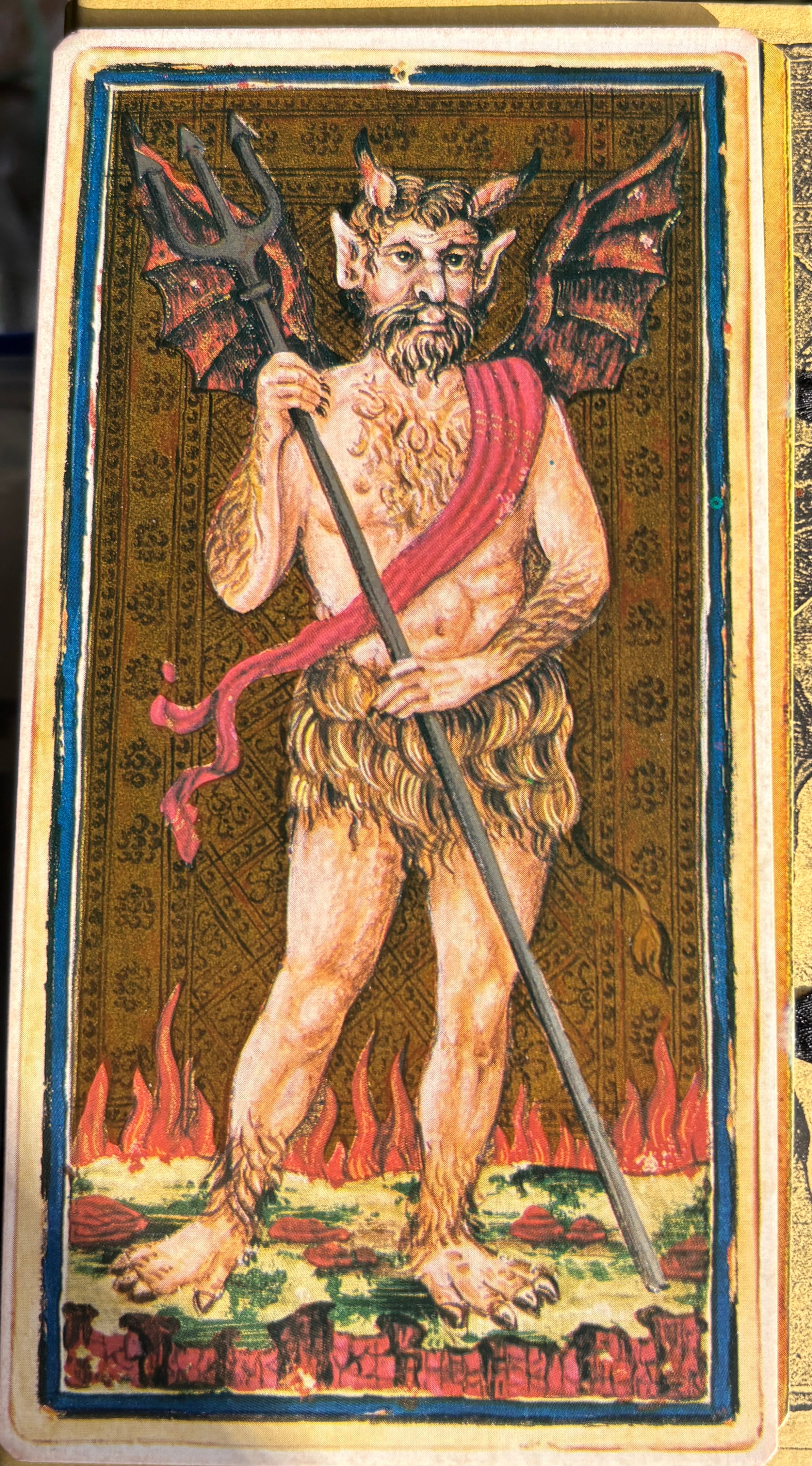
Nobody knows why, but none of the earlier Italian tarot decks have the Devil or the Tower cards. Whether they just happen to be missing or were never even there, it’s one of tarot’s enduring puzzles. Modern editions of 15thc Visconti deck repros have commissioned illustrators to make their own versions of these cards, as tarotists expect to see them. 15th tarot was, of course, just a card game. Probably. Like everything in tarot history, this is disputed.
Now we’ve taken a stroll past some of York’s stained glass devils, let’s walk through some versions of the 15thc Visconti tarot deck and see how the modern devils stack up, and how “authentic” they might be, as recreations of 15thc European depictions of Old Nick.
But before we look at the Visconti Sforza and di Modrone/Cary Yale decks, here’s a later, Marseille-style deck’s original Devil, to show you what form the medieval/Renaissance European devil evolved into. As you’ll see, some of the artists illustrating the missing Visconti devils refer to the Marseille-style devil, rather than the 15thc Italian one, so it may be useful to see a fairly typical Tarot de Marseille style devil, first.
Here’s what people often think of when they conjure up a tarot devil in their minds, the classic (later) French Tarot de Marseille style:
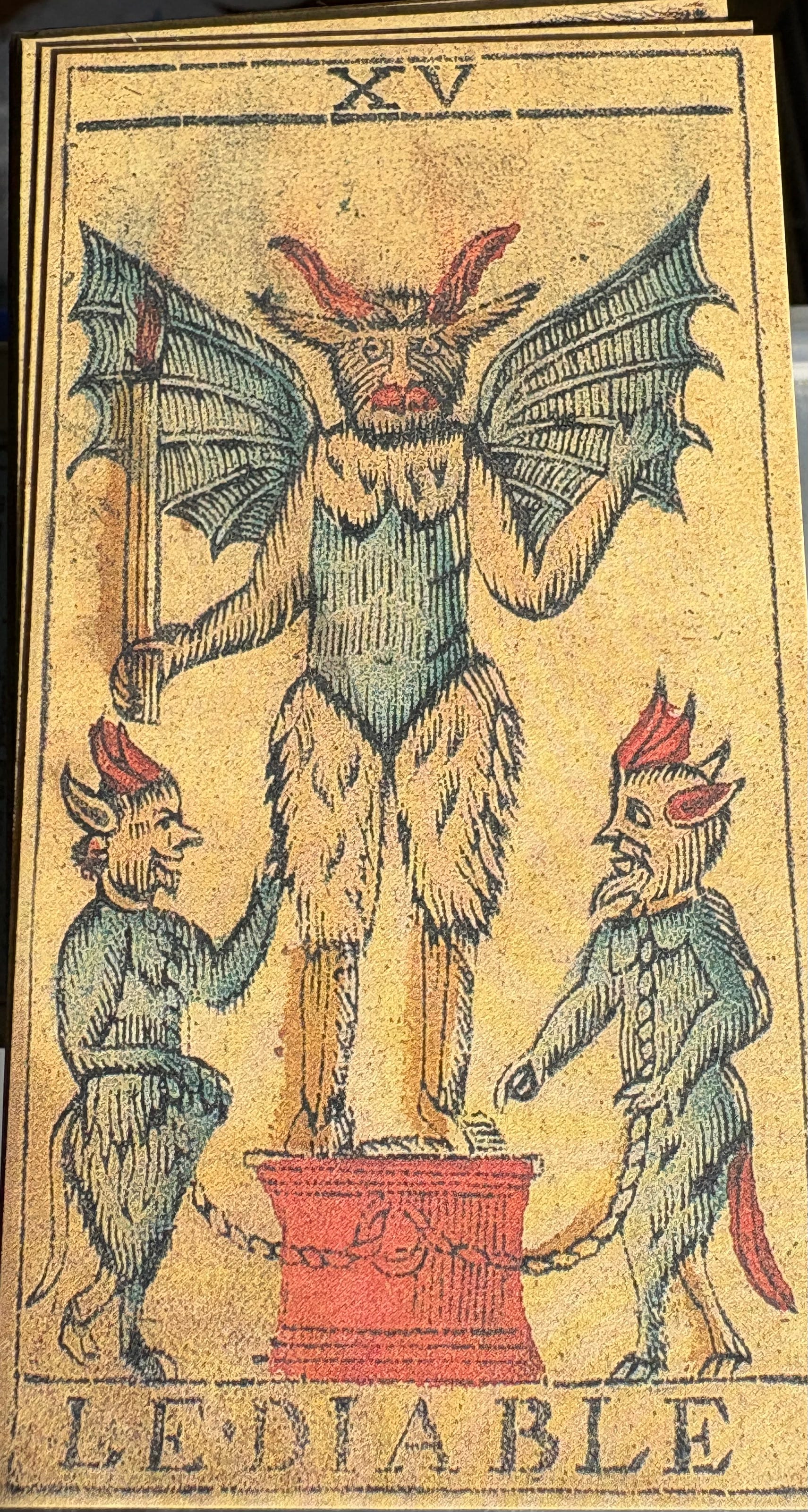
Here we can see the French tarot devil has evolved into a sort of half-human-half-goat. It has goat hooves, a goat head, is androgynous but still has the bat wings and the overall furriness. Now it is on a dias and has two chained minions. I am not yet finding goat-y Baphomet style devils in the 15thc. stained glass depictions, nor the chained up slaves. (My study of York medieval stained glass will be ongoing). But where are our hairy, tusky, late gothic-style devils?
Rather than chaining up minions, York’s stained glass devils seem prone to cheerfully stuffing them into fiery cauldrons, or sit on kings’ shoulders whispering into their ears, burn down houses as a distraction from a boring sermon, or jump out on unsuspecting men out on a walk. As well as the Devil, I found depictions of demons, who were satan’s little helpers. They seem smaller versions of the devil; naked, humanoid, ugly. (See previous post).
For insight into what might have happened to the 15thc Devil card, read Mary Greer’s post, here.
These decks are just the ones in my current collection and this is not exhaustive.
I won’t cover the Brambilla Visconti deck here as I don’t yet have a copy, but intend to get one in the coming months so will visit it, then. Currently, there is an Il Meneghello Brambilla tarot which has no modern reconstructed cards and Lo Scarabeo will be publishing their version of Brambilla later this year. That deck will have the missing cards reconstructed. My decks are all currently either Visconti-Sforza or Visconti Cary Yale decks.
Fragments of Visconti decks appear in various museum collections across the world. But the three almost complete/complete-ish decks are: Visconti-Sforza (AKA Colleoni-Baglioni), Brambilla and the Cary Yale (AKA di Modrone) decks. Dates of these decks are disputed but it’s likely we’re looking at between the 1440s-60s. So contemporaneous with the War of the Roses, here in the UK, and the pre-reign lifetime of Richard III. (Whose subsequent demonisation as “mis-shapen”echoed our Renaissance devils but that’s a story for another day).
I’ll start with the original Lo Scarabeo version of the Visconti-Sforza deck, (original deck now attributed to Bonifacio Bembo, Cremona, c.1460)1 which was the first version of the Visconti I owned, probably around 1998-9. This is the older version of the Lo Scarabeo deck, which has the replacement art done by Luigi Scapini (he also did the Medieval Scapini deck for US Games). Here’s Scapini’s original devil from the Lo Scarabeo Visconti-Sforza, which was replaced in later editions with a different Devil:
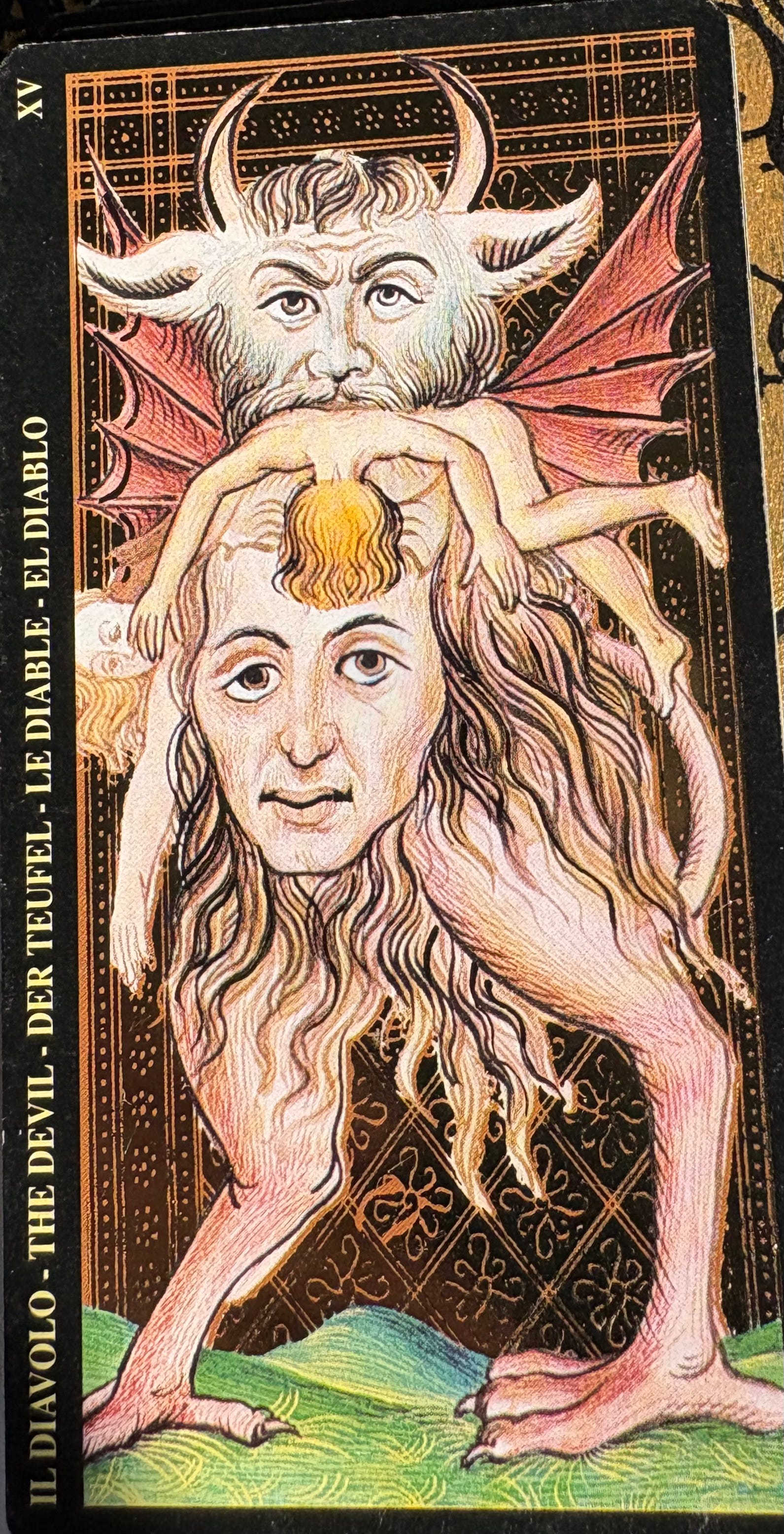
This idea of the Devil like a Dr Who “Abzorboloff” (with a face or faces in his belly or elsewhere on his body) pops up a century or two after Visconti, with the Tarot de Marseille and similar traditions based on it like Bescançon and Swiss decks but does seem to spring from much earlier mainstream European culture.
I’ve yet to see the faces-in-belly devil in stained glass but nothing would surprise me. Will update here if, as and when I find him.
This devil is browny/red with horns, is hairy and has bird-like feet so he’s not too far off the 15thc. mark. The fact he’s eating a victim is reminiscent of the Visconti emblem - a viper eating a person with the human figure hanging from its mouth. AKA as “the biscione” or “vipera” symbol. The biscione is now the symbol of Milan, which shows you the influence the Viscontis had, that reverberates down to this day.
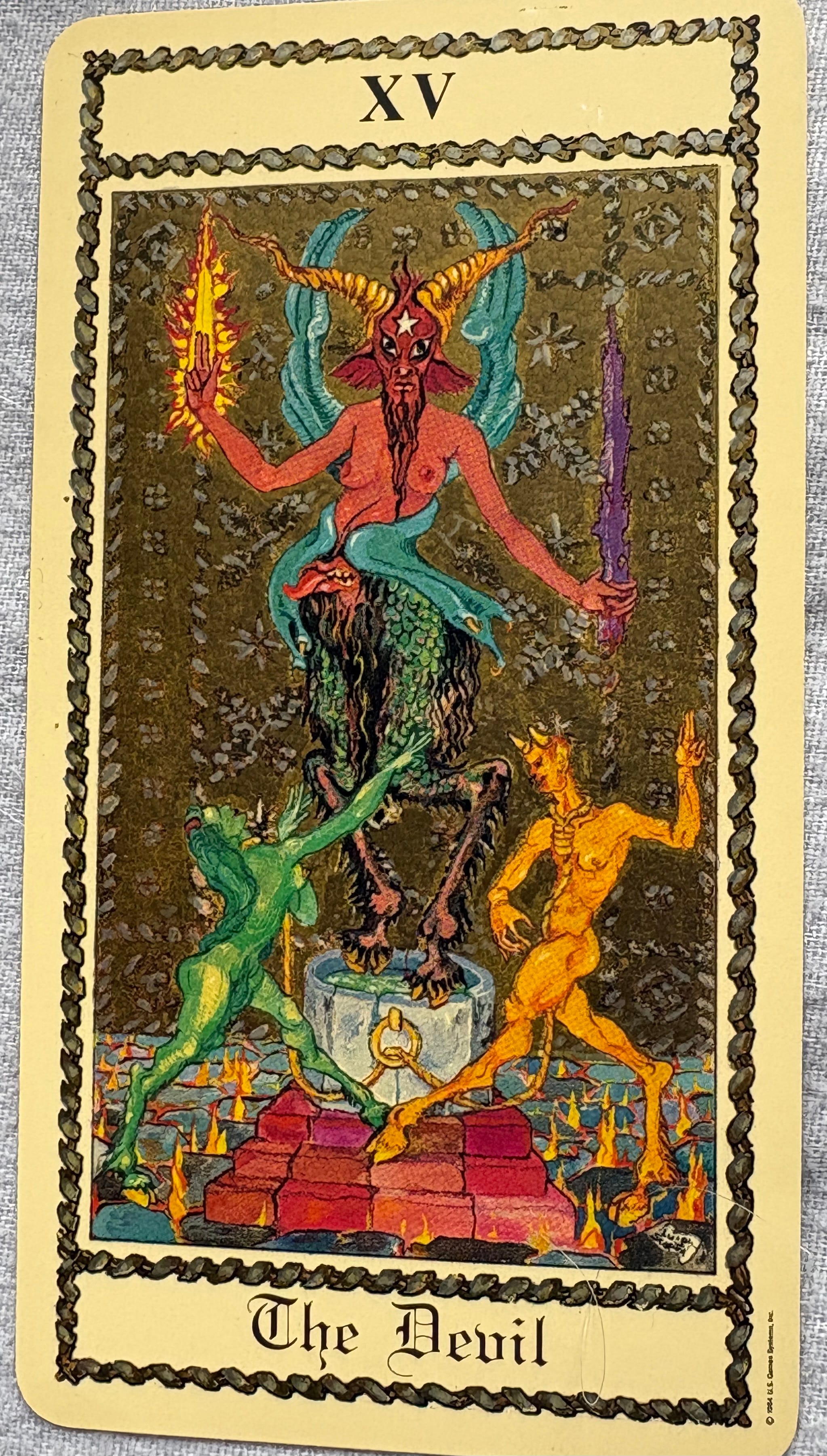
Here, just for interest, and because I happen to have the deck, is Luigi Scapini’s US Games androgynous, Baphomet style Devil for his own (non-Visconti) deck, The Medieval Scapini Tarot ©1985:
Then there’s a more recent Lo Scarabeo offering, the Golden Tarot of Visconti, 22 card trumps-only deck. These illustrations (and new card backs) replaced the former Lo Scarabeo ones, above, around 2002. But can also be found on a trumps-only version:
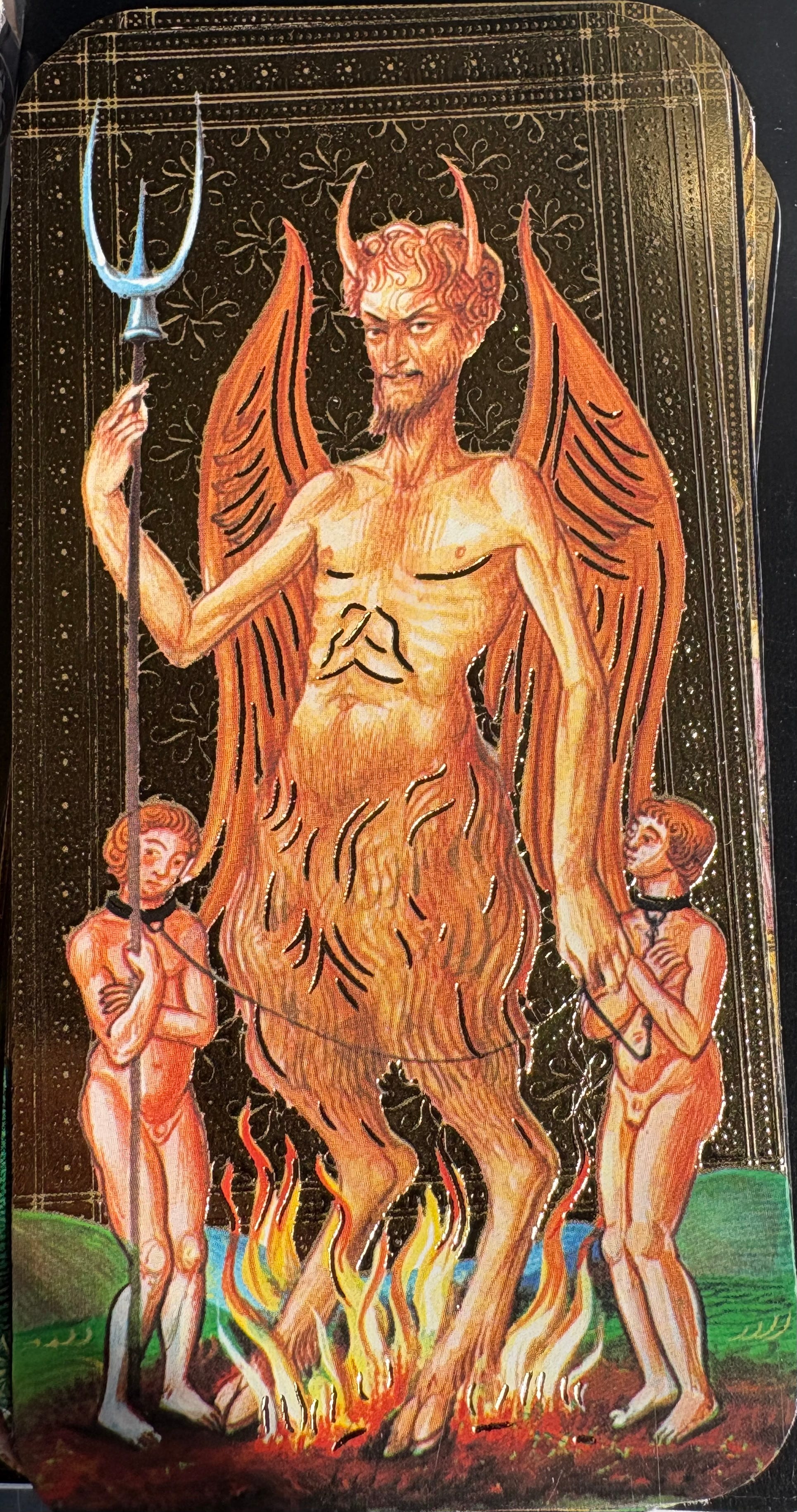
I trimmed off the wordy Lo Scarabeo borders. Fortunately, their more recent offerings come without verbiage. It looks like they are going to bring out their version of the Visconti Brambilla deck, later this year - I can’t wait. Currently, only Il Meneghello have a version of Brambilla.
The artist of the above Devil card is Bulgarian artist, A. Atanassov - the deck from 2006. This devil leans way too much into the later, Tarot de Marseille style devil, for him to be of a piece with the 15thc Visconti cards. The talons and bird-like claw feet are changed for a classically influenced goat-y Pan style devil; he’s more like a faun, which is another way of representing his hairiness, possibly, but leads us away from the 15thc canonical devil to the later Pan-style archetype. His chained minions are also redolent of the later, TdM style devil. I’m sure many medieval glaziers would have approved of the flames, though.
He has the look of a louche Jason King - something very 1970s’ satanist-in-a-movie about him.
The next Lo Scarabeo devil is that from their more recent Visconti di Modrone deck. This deck is fascinating. Like other Viscontis, it has the added 3 theological virtues cards - Faith, Hope and Charity which seem to have fallen out of tarot, later on. It also has two extra court cards per suit - a female Page and a female Knight, which makes it fascinating.
On the Lo Scarabeo di Modrone, Jason King’s head gets swapped out for a goat-like devil’s face:
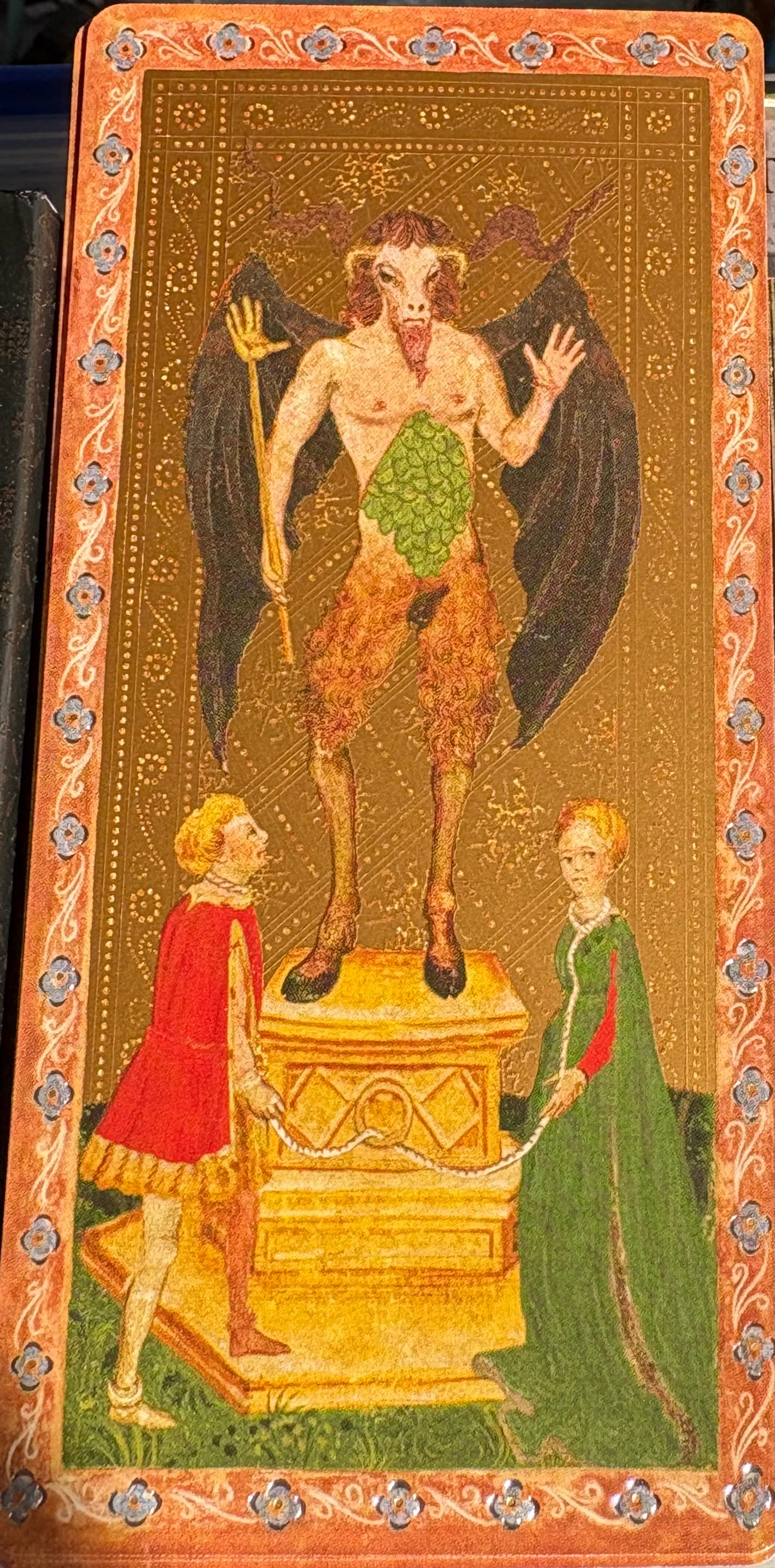
This is a fully restored deck, not a facsimilie. The restoring artist here is Mattia D’Auge. The deck originated as a Kickstarter in 2019. I have the later, mass market edition. This devil is, again, more Pan-like and he has his Tarot de Marseille style, chained captives, a goat’s head and less bat-like wings than the typical 15thc devil we saw in our stained glass examples.
Compare this to the older, US Games’ recreation of The Devil card, for the same deck which is another 70s’ Hammer Horror style image:
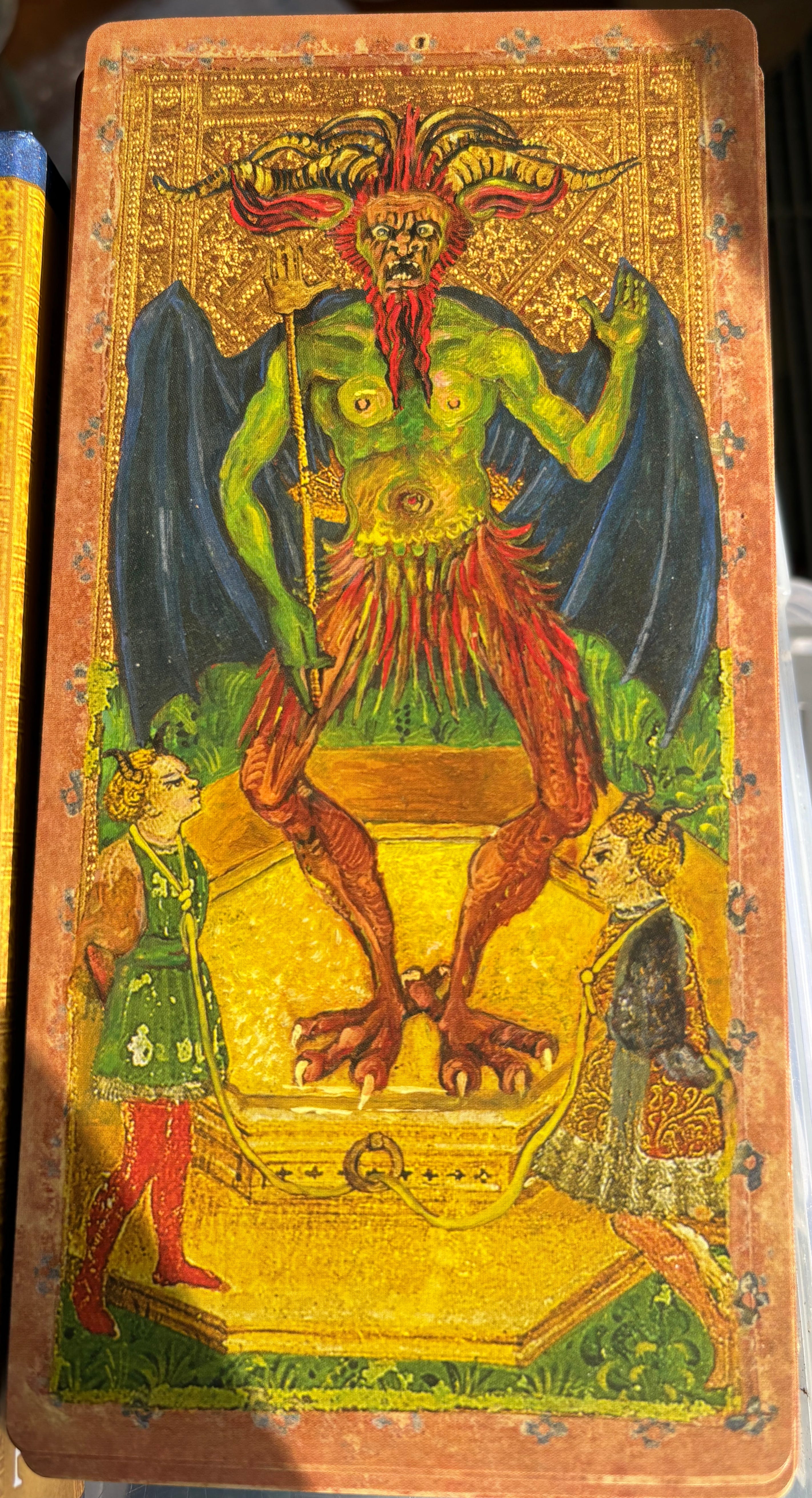
This deck has 67 extant cards, including some extra court cards; a female Page and female Knight for each suit. The deck has been attributed to Andrea Bembo but this is uncertain and it has been dated variously between the 1440s-60s.
Luigi Scapini again painted the missing 19 cards for US Games. A much later version has an updated, expanded and in colour “Little White Book” and came in a more rigid, clam-shell type box. (Version pictured). The cards also, as above, have no white borders like the 1980s’ version but retained Scapini’s art. I prefer his first ever version of the Devil, for Lo Scarabeo, above. (The Abzorbaloff devil). Taste in devils, as in anything else, is subjective, I guess.
Scapini’s US Games Cary-Yale Devil is not entirely close to the canonical 15thc. devil but at least still had the falcon’s legs and talons. But he had the androgyny of the later TdM style devils and also the chained minions. Whilst the stained glass devils and demons might be found cheerfully stuffing sinners into cauldrons, or visiting saints on their death beds, they weren’t really chaining and capturing, as such. This seems to be a tableau more appropriate for the Tarot de Marseille than the earlier, Italian decks.
Finally, we come to the deck which has the “best” 15thc style devil, in my humble view.
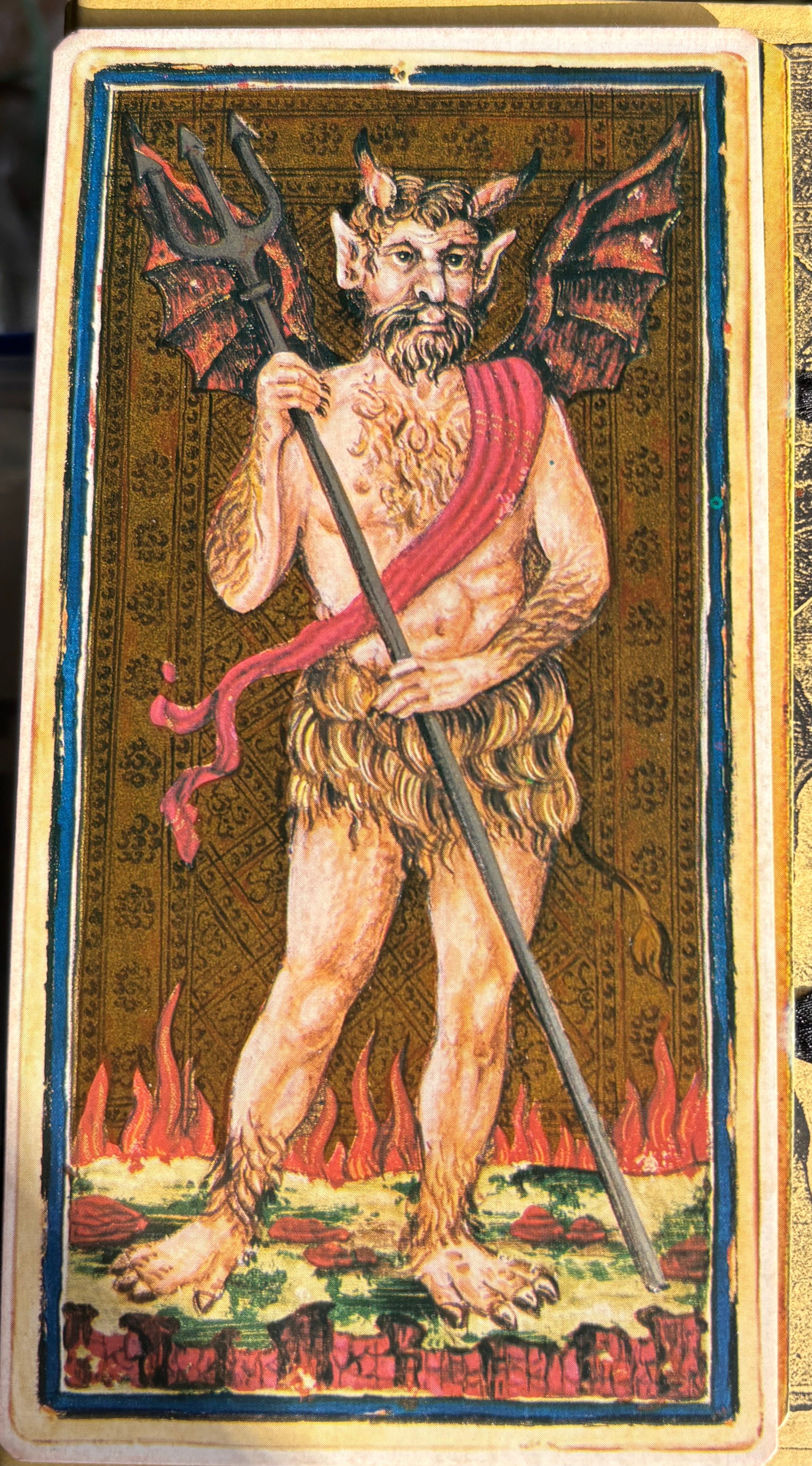
It will come as no surprise to tarot afficionados, that the closest in spirit to the 15thc devil comes from Il Meneghello in Milano. Here, finally, is a hairy, clawed, humanoid devil with horns and red/brown bat wings. And no chained minions. Also some medieval style fiery flames for added élan. Giovanni Scarsato designed the replacement cards including this fellow. This is far and above, my favourite. More human, less goat and some bat. The workshops that created St Martin le Grand’s stained glass devils would recognise this one, on sight.
I was lucky enough to get hold of a 1996 version (cheaper, because it had lost the Little White Book - and sadly, that meant I don’t have the Limited Edition number for my deck as they were hand-written on the LWB). This appears to use a metallic ink for the backgrounds, which is hard to photo and I think the current edition no longer does - it’s more subtle than foiling but still looks bling, in a low-key kind of way.
Il Meneghello’s version is far and above the closest to York’s 15th century stained glass devils I have, although I’m so grateful to US Games and Lo Scarabeo for bringing out the earliest versions of Viscontis, which were exciting to behold, when we first saw them and I am still thrilled to have, all these years on.
Resources
Books
The History of Tarot: Truths and Legends, Giordano Berti, Rinacimento Italian Style Art, 2022-5.
The Visconti Sforza Tarot: Milan from the Viscontis to the Sforzas, Cristina Dorsini, Il Meneghello Edizioni, 2019.
Visconti di Modrone Tarot” Art in Milan in 1400, Cristina Dorsini, Il Meneghello Edizioni, 2025.
The Visconti-Sforza Tarot Cards, Michael Dummett, pub. George Braziller, 1986.
The Encyclopedia of Tarot, Volume 1, Stuart R. Kaplan, 1978.
Websites
https://marykgreer.com/2018/01/27/what-happened-to-the-visconti-devil-cards/
https://tarot-heritage.com/from-trionfi-to-majorarcana/il-diavolo-le-diable-the-devil/
https://tarot-heritage.com/2017/08/27/comparing-visconti-sforza-replacement-cards-the-devils-in-the-details/
https://moakleyupdated.blogspot.com
The History of Tarot, Giordano Berti, Rinascimento Italian Style Art, ©2022-25