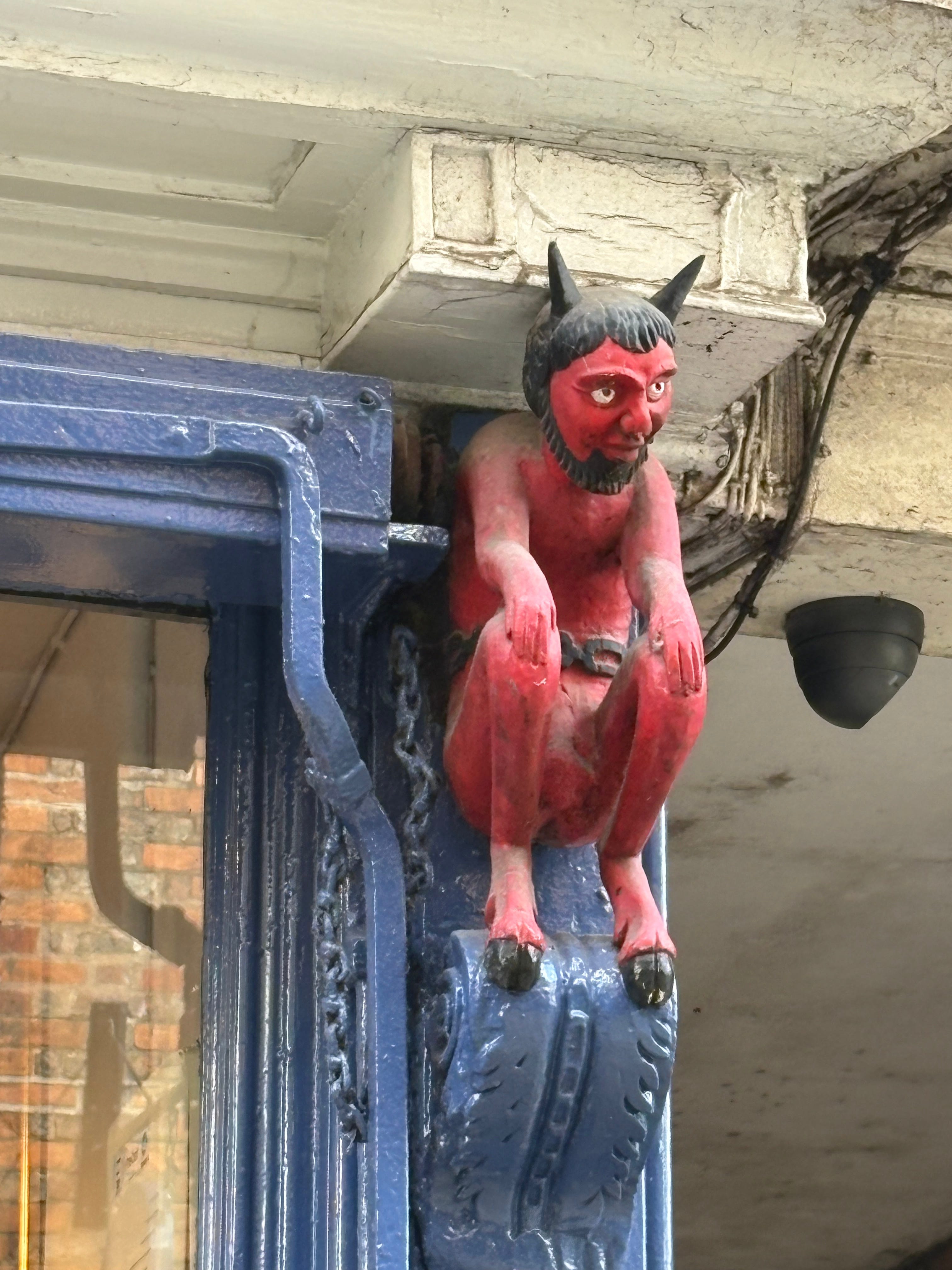
The Devil's Prayer Book
Part 1: In which we look at some 14th-15th century York devils/demons...

There are no Devil cards in extant Renaissance Italian tarot decks. Why not? Theories abound. Devil card used in ritual magic? Or destroyed in Inquisition-style “Bonfires of the Vanities”? Was the image too scary or shocking? Or were there never Devils (or Towers) in early decks from Northern Italy, anyway?
Bottom line is, we don’t know why there are no 15thc Italian tarot devils - or even, if there ever were. None are extant. Major cards were un-numbered so we don’t have that clue, either, to help us decide whether the Devil and Tower were “missing” or simply, never existed at that point.
St Bernadino of Siena delivered powerful, and widely distributed, sermons in the 1420s, condemning playing cards as the “Prayer Books of the Devil” (The History of Tarot, Giordano Berti, pp.74ff). And even condemned illustrated religious breviaries, let alone card games like trionfi. To him, the English medieval illuminated manuscripts would also have belonged to the Devil.
So it may be that tarrocchi devils didn’t exist in the 15thc. Or, were at some point, vulnerable to being temporarily erased from the tarot, only to reappear later with the Tarot de Marseille?
There are several Italian 15thc Visconti decks; one almost complete, the others fragmented. Now available as facsimilie or restoration decks, and usually with a contemporary artist’s Devil and Tower. I’ll write in more detail about the extant Visconti decks in Part 2 but for today, let’s take a casual stroll past some actual devils that are, more or less, contemporaneous to the Visconti tarot decks and see what an English devil might have looked like in the 15th century.
These are English 15thc. devils - from around the time of the War of the Roses, here. There’s no saying that an English devil is quite the same as an Italian devil of a similar date. But I thought I’d take a look at the symbology, anyway and let’s see what we find.
We will continue in our quest to find stained glass devils so I will return to this at some point. There were surprisingly few. And some demons/Satan’s little helpers, as opposed to the Devil himself so caution is needed, deciding whether the image is a devil or a demon.
York Minster has around 6 or 7 devils in its stained glass. Most, too high up to photo. We did our best and had some help finding the devils from one of the Minster’s volunteers. It just happened that the first person we approached for help was something of an authority on the stained glass and took us patiently from devil to devil. Some we couldn’t photograph but here’s a couple we did and for one, we had to photo an info board as that window is currently undergoing restoration.
From a 14thc window in the North aisle, a hairy, green devil:
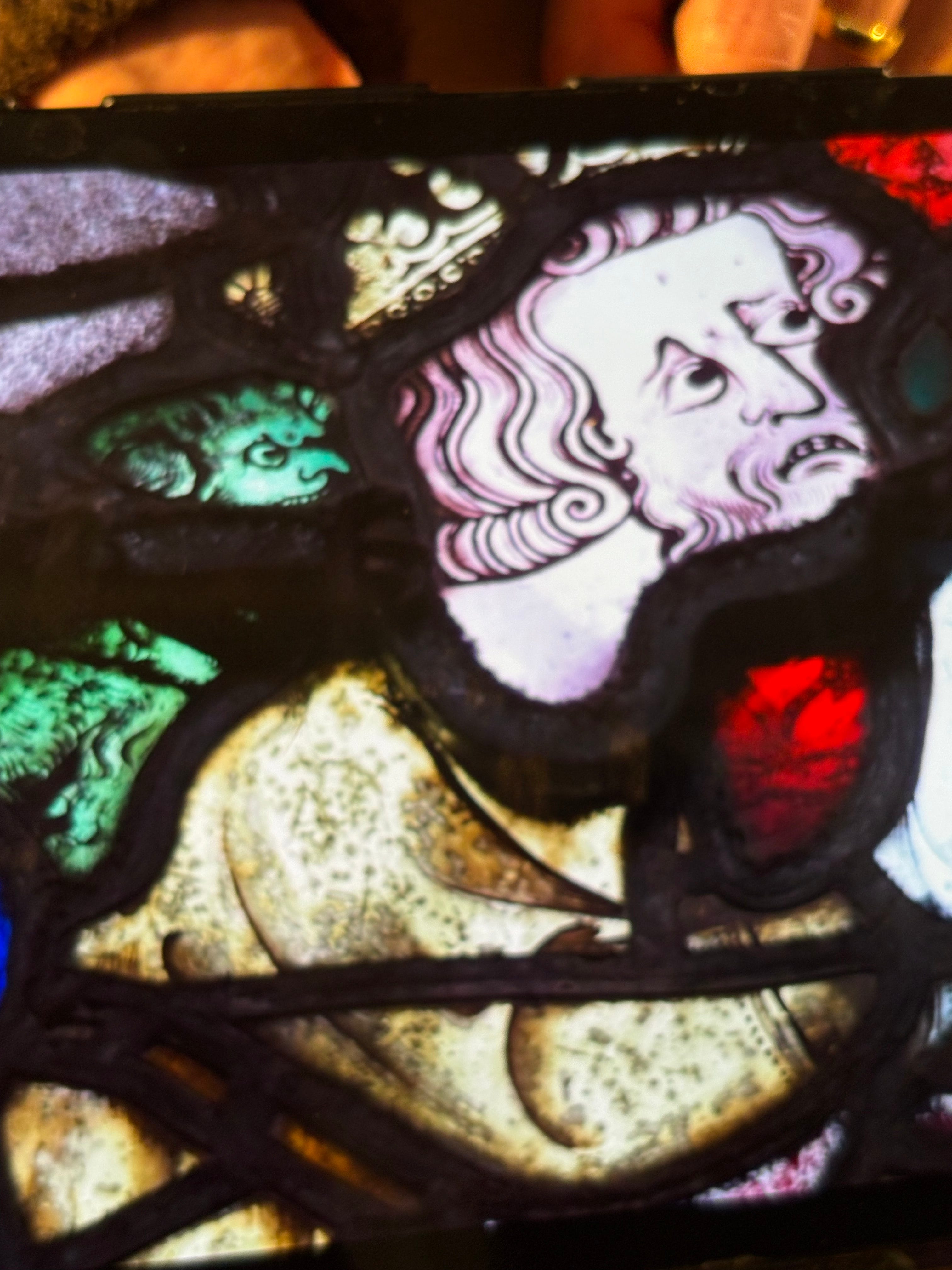
This “devil” may well have been an imp/demon as he is so small. Also atypical because he is green. This window dates from a century before the devils we’re looking for. There were some other demons stirring dead people in a fiery cauldron in another window along the South aisle, but that was too high for us to get a usable image at all.
Below: from the St. William window, a man out walking, attacked by the devil. Notice this is the classic 15thc “hairy devil” - a humanoid body, covered with hair. Like some other devils of a similar date, he has a long, upturned nose.
When I saw it, I wasn’t sure if this is canon just for English devils or was also found across Europe. But according to the deck-book accompanying Lo Scarabeo’s Visconti di Modrone, iconography of the devil had roots in “the Etruscan God of Hell, Charun… representing it as a monster with a hooked nose, tusk-shaped teeth, pointed ears, bat wings, falcon or goat legs, and horns. On various occasions it also has a face on its abdomen…”p.36. )
Our devil here is brown, not the bright red or green we might expect and has a naked body covered with fur, almost like the sasquatch of folklore. He also has horns and specifically bats’ wings and claws/talons. No “hair skirt” as in some (modern) tarot depictions but just hair all over.
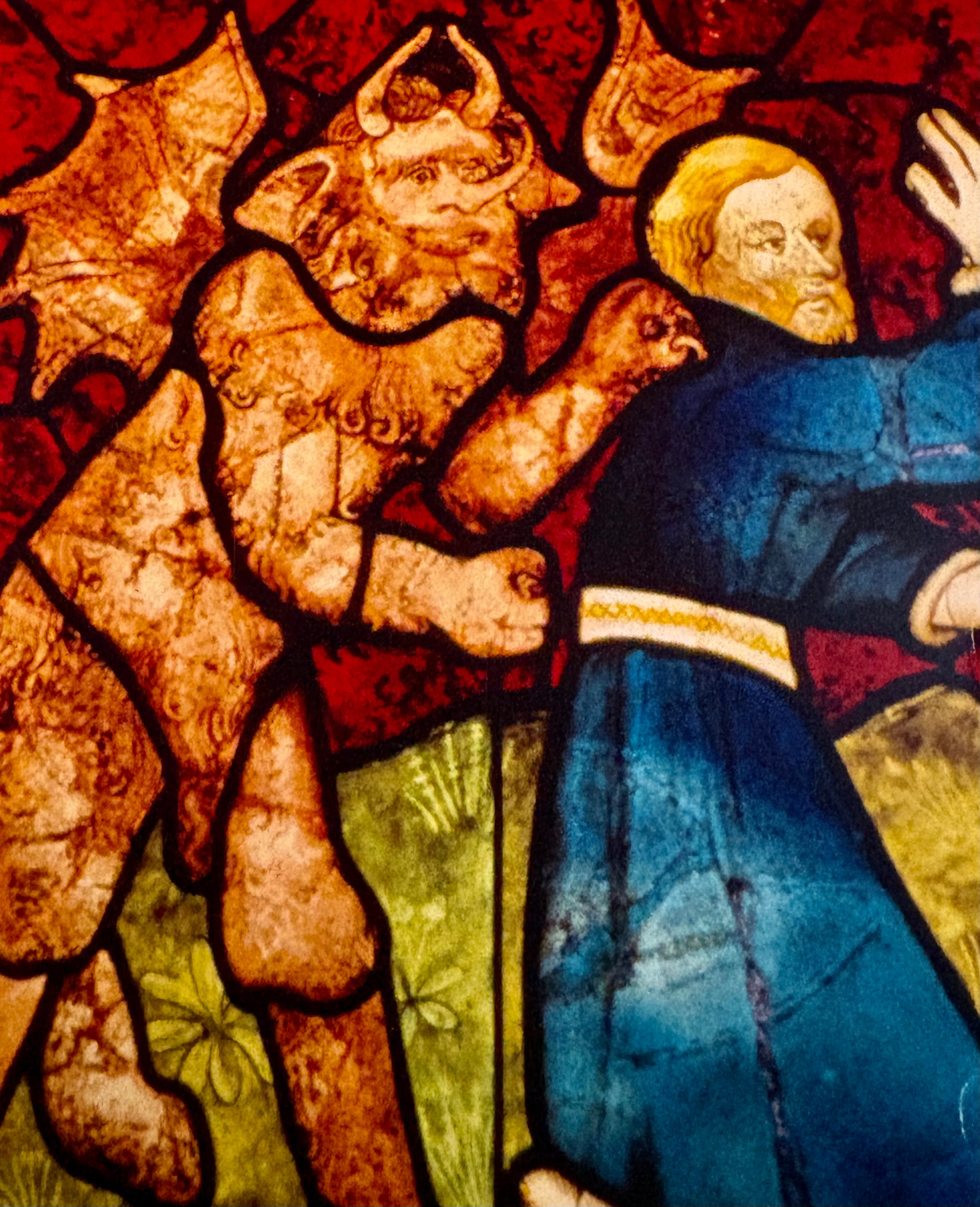
So it seems a depiction of any red/brown, naked, hairy, ugly Devil with bat’s wings and claws might be on the money for illustrators trying to capture a typical 15thc. devil.
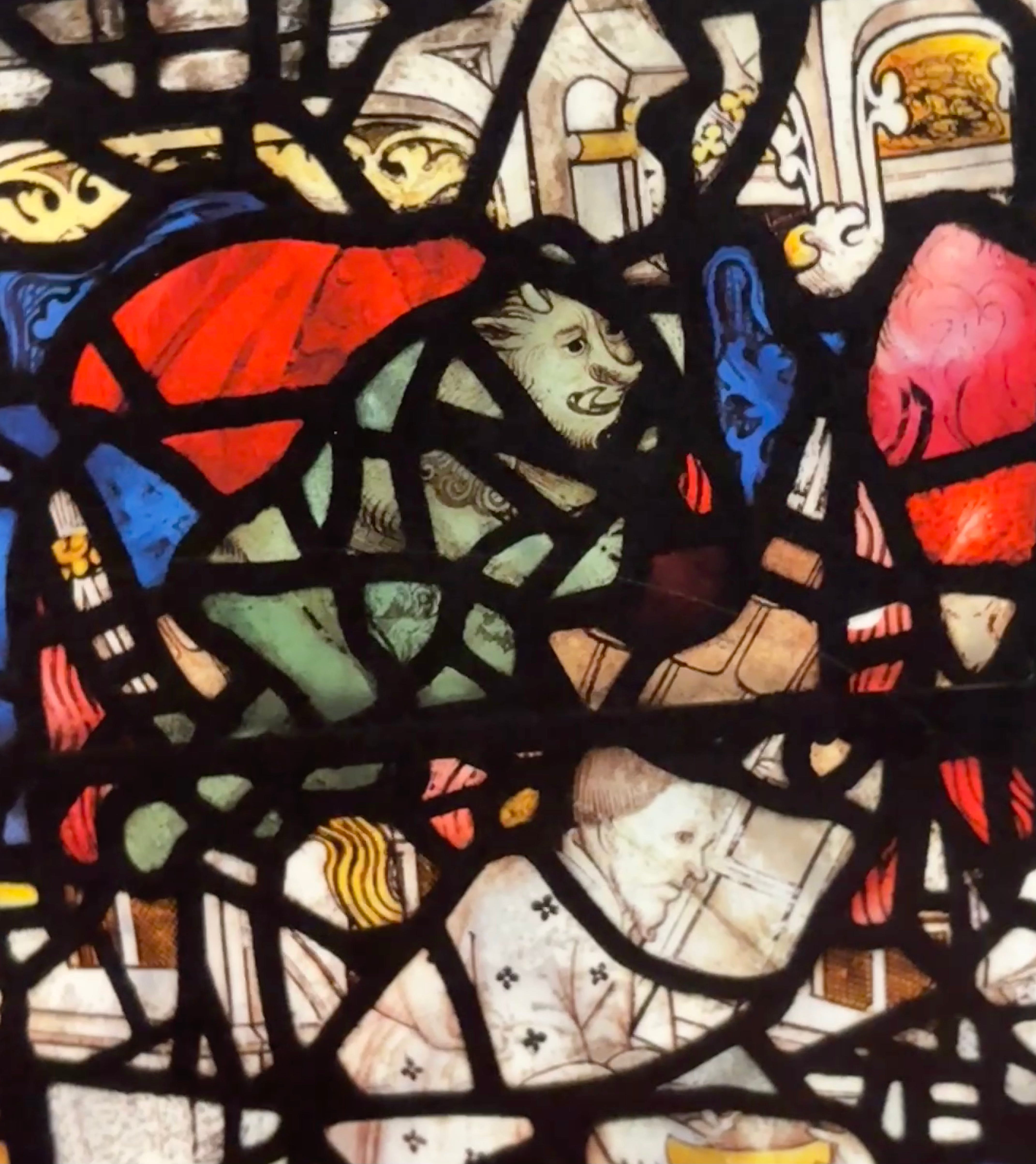
Image here taken by photo’ing the current info board, as St.Cuthbert’s window is currently being restored.
This is maybe a minion “demon” rather than the devil himself, and maybe that’s why he’s green but again we have the long, pointy, upturned snout, hairiness and horns. This window was made around 1440 so is almost exactly contemporaneous with the earlier Visconti deck. Apparently, the demon was creating the illusion of fire in someone’s home, to distract from the saint’s preaching.
Onto one of York’s most spectacular and interesting churches, over the river and one that’s slightly off the beaten tourist track, All Saints, North Street. My favourite ancestor married here in the 1820s, so this is one we have visited a lot. Here’s a fascinating YouTube video on the church’s hermit, still resident in the early 1960s.
Another time, I’ll write about the Judgement card in tarot and medieval/Renaissance depictions of Doomsday as there are some brilliant stained glass windows showing judgement, including All Saint’s unique, wonderful Pricke of Conscience window. Which deserves a post of its own.
But here at North St can be found, in a light at the very top of the Pricke of Conscience window, this red/brown devil (It was morning and the light was round the other side of the church so this picture isn’t as clear as it might have been).
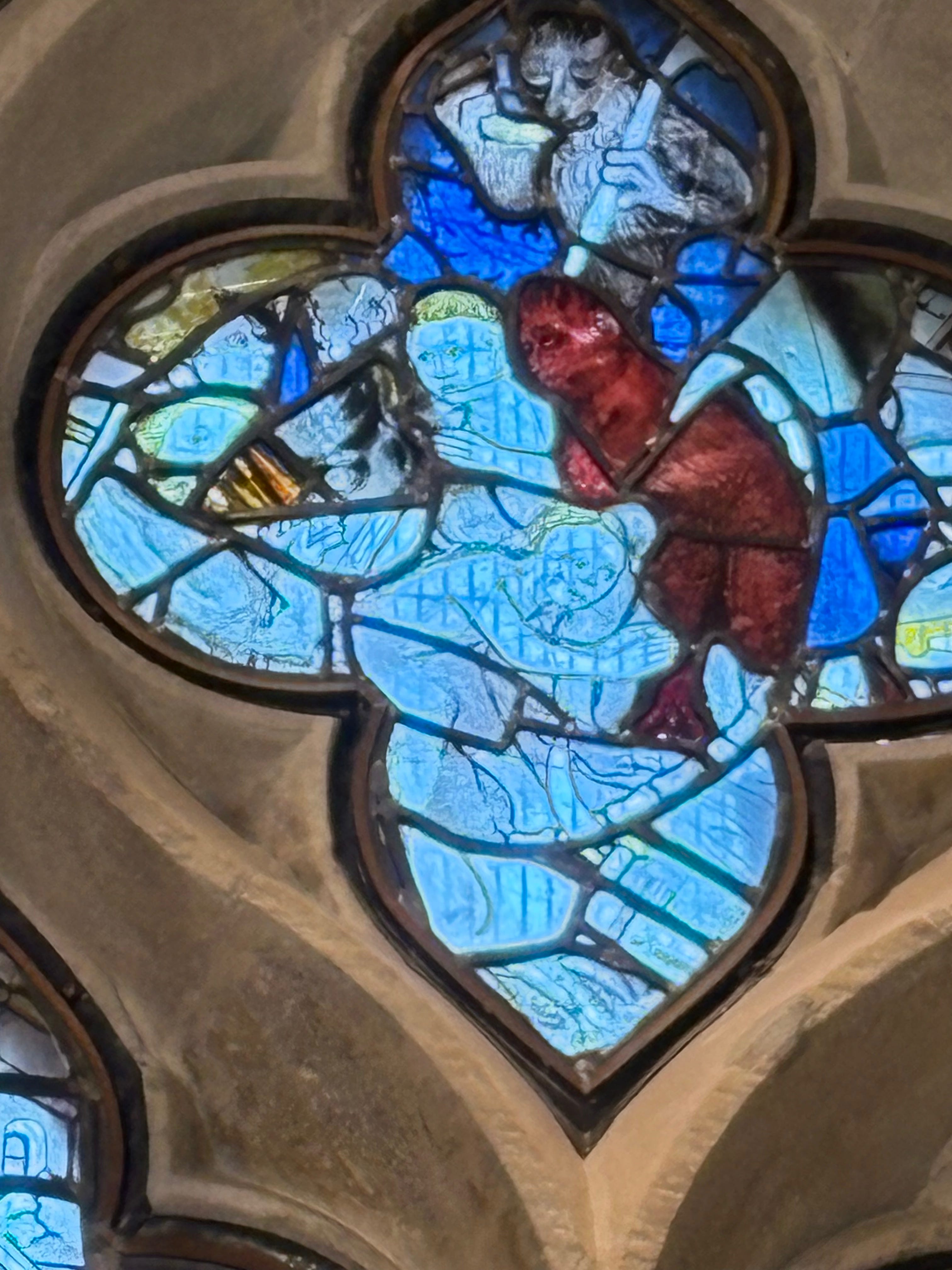
Here, the early 15thc. devil is reddy-brown, hairy, again with birdlike talons. Again, this might be a demon (also the transparent figure above him?) rather than the Devil himself, pushing sinners towards the Last Judgement.
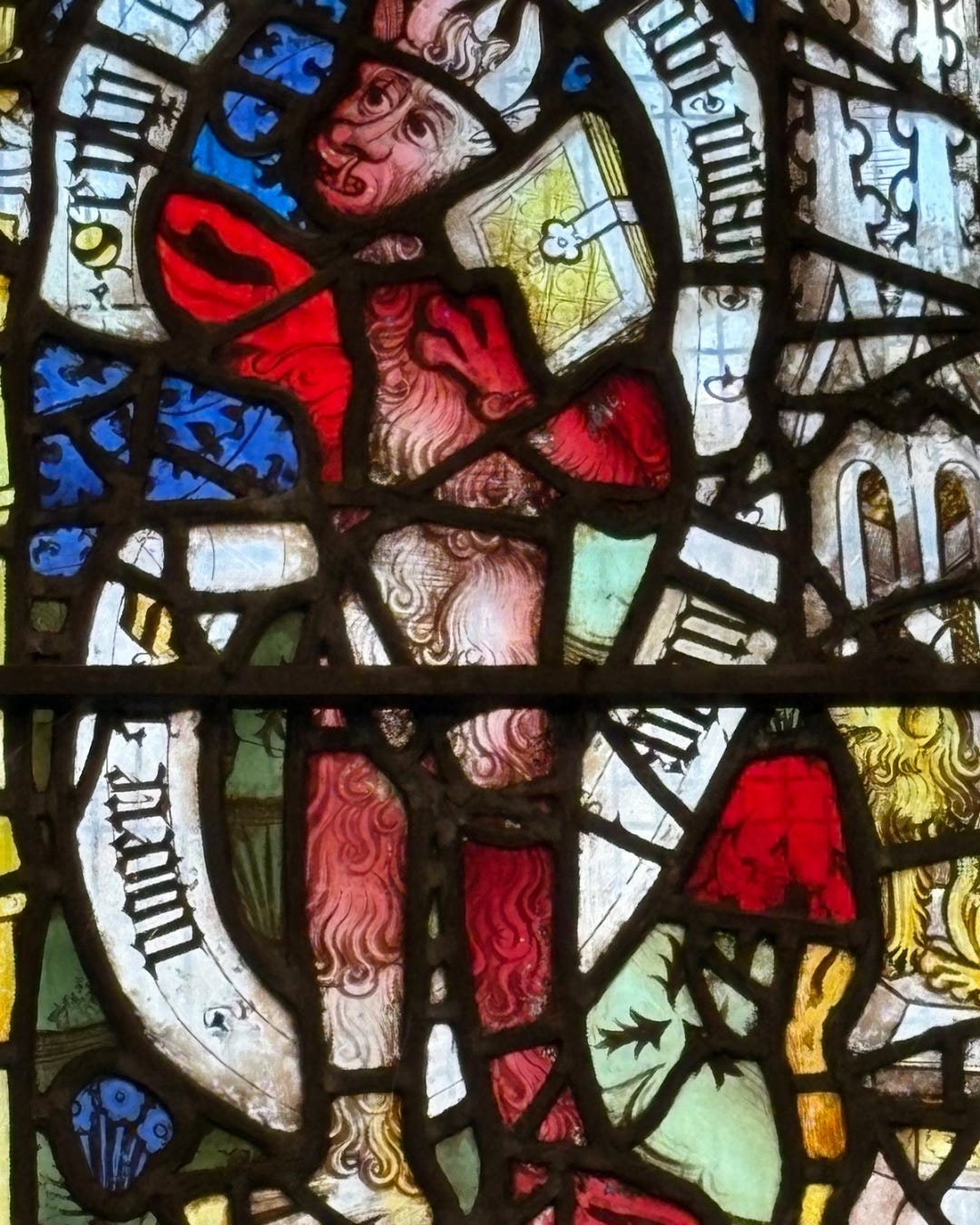
Our final (and maybe, best?) York devil for now comes from St Martin le Grand, Coney St, York.
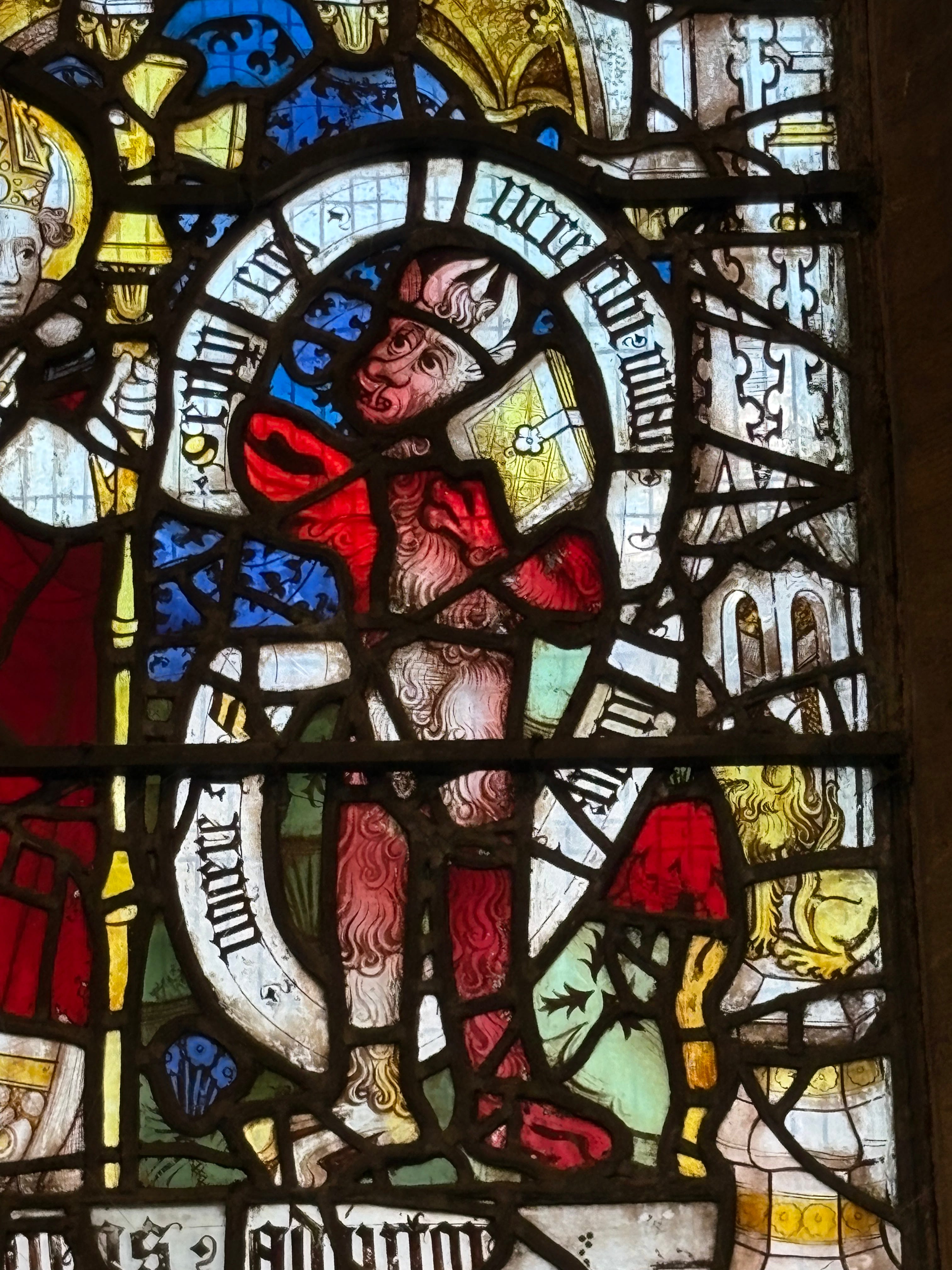
The St. Martin window was donated by the vicar, Robert Semer, in 1437. Glazier’s workshop unknown (sometimes, the glaziers’ workshop is known). The date puts this classic, hairy 15thc devil very close in date to the earliest iteration of the Visconti deck. The devil was shown here, being forced to carry the saint’s missal. Here he is again, at St. Martin’s death, peering at the missal:
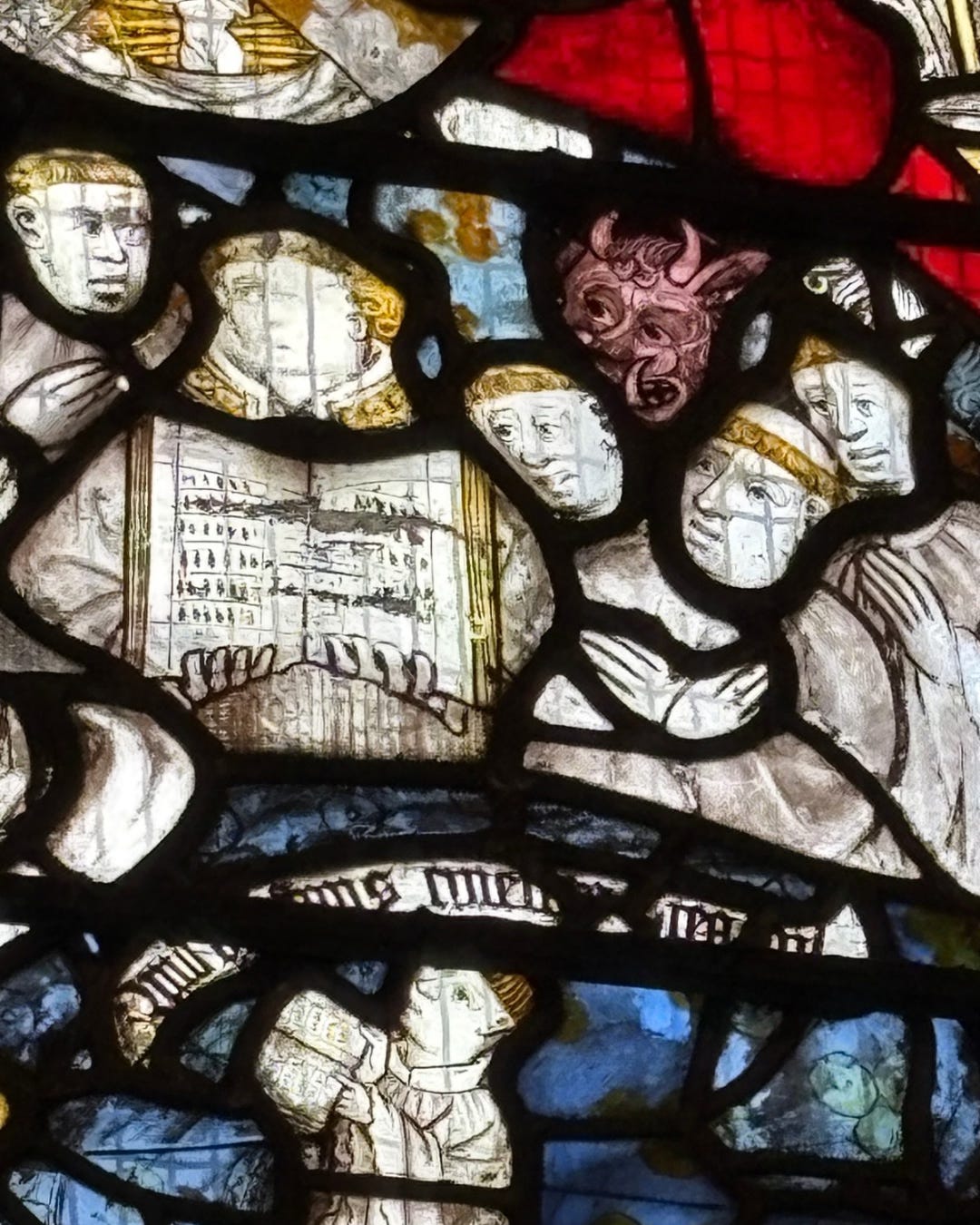
So, the standard (English, at least) 15thc Devil appears to be browny red, naked, hairy, with possibly a tusk, certainly horned, with talons and bird claw-like feet like a falcon - we’re not really seeing the goat-legged devils in our stained glass (yet - I may do at some future point). Sometimes, not always, with bat wings. Thinking of the “wildness” of the hairy, unclothed being, compare medieval English literature’s descriptions of the wild man of the woods, or wodwose).
I think the wodwose are maybe deserving of their own post, in the future, as they’re the sort of folklore I’ve touched on, in the past. So I will return to them at some point.
Next time, we’ll walk through the versions of the Visconti deck I currently have which have the recreated Devil card and we’ll see how the modern “recreated devils” stack up, and how “authentic” they might be, as recreations of 15thc European depictions of Old Nick.